Specific Surveillance Systems
| Objectives | - To determine types of chemical incidents in Lebanon - To describe exposures by time, place and person - To determine the health risk of and the need for further investigation - To establish a comprehensive national chemical exposure database - To help develop a strategy for managing the consequences of the exposure - To provide information to support prevention and control programs |
|---|---|
| Sources of data | Data sources are both Emergency Department in public and private hospitals |
| Target case | Any person presenting at ER with acute or chronic toxicity, with or without signs of illness, with or without a toxic dose |
| Protocol | National protocol: En |
| Reporting form | Chemical incident reporting form |
| Results | Latest monthly national bulletin |
| Objectives | - Monitor/measure weekly absenteeism proportions to be able to detect alerts and outbreaks - Assist decision makers on proper control measures, such as school closure |
|---|---|
| Sources of data | - Both public and private schools across Lebanon |
| Target events and diseases | - Absenteism - One of the following mentioned in any medical reports: gastro-enteritis, acute respiratory infection (influenza-like illness), measles/rubella, mumps, acute jaundice, tuberculosis, conjunctivitis - One of the following detected during inspetioc: lice, scabies |
| Guidelines | School-based surveillance guideline: Ar, En, Fr |
| Reporting form | Weekly school reporting form |
| Results | Latest weekly national bulletin |
| Objectives | - Monitor/measure weekly positive tests proportions to be able to detect alerts - Identify outbreaks - Early rapid response - Avoid dissemination of diseases - Assist decision makers on proper control measures |
|---|---|
| Sources of data | - Data sources are both public and private laboratories across Lebanon. |
| Target tests | - Culture: CSF, blood, respiratory specimens, stool - Other stool test: direct parasitologic exam, rotativus antigen detection - Serology: VHA, Measles, Rubella - Inlfuenza: rapid test, PCR |
| Guidelines | Laboratory based mortality surveillance guideline: Ar, En, Fr |
| Reporting form | Weekly laboratory reporting form |
| Results | Latest weekly national bulletin |
| Severe Acute Respiratory Infection Surveillance (SARI) | |
|---|---|
| Rationale | Severe acute respiratory infections (SARI) can be the result of several agents: viral, bacterial, and parasites, even though bacterial and parasitic agents can be less common. Among the viruses, influenza viruses are among the major causes of SARI. Any preventive or control measure related to Influenza requires the availability of surveillance, including the seasonality pattern and the causative agents. SARI surveillance in Lebanon was established in collaboration of the World Health Organization. |
| Objectives | The objectives of Severe Acute Respiratory Infection (SARI) in Lebanon are: - To estimate morbidity (incidence) of SARI in Lebanon - To identify baseline figures and alert/outbreak thresholds - To describe SARI cases by time, place, person, susceptibility, severity - To identify circulating influenza strains and detect novel viruses - To contribute to the global influenza surveillance |
| Sources of data | Data sources are hospital sentinel sites. Sentinel surveillance focuses on collection of data from specific pre-selected health sites to carefully monitor a specific disease. The collection of the data is systemic. The sites are selected based on key criteria: willingness, activity and representativeness of the population. The current sentinel sites are: - In the mohafazas of Beirut and Mount Lebanon: Rafik Hariri University Governmental Hospital (RHUH), American University of Beirut Medical Center, Quarantina Governmental Hospital - In the mohafazas of Bekaa and Baalbeck/Hermel: Baalbeck Governmental Hospital - In the mohafazas of North and Akkar: Kheir Hospital |
| Case Definition | An acute respiratory infection with: - History of fever or measured fever of >=38°C and cough - Onset within the last 10 days - Requiring hospitalization |
| Case Investigation | For each SARI case, data is collected including demographical and clinical data. Also, clinical specimens are collected for laboratory testing. The needed specimens are: nasopharyngeal swab (preferable one), oropharyngeal swab, bronchoalveolar lavage (if done), or tracheal aspirate (if patient intubated). |
| Laboratory Testing | Laboratory testing for SARI patients are performed at the National Influenza Center at RHUH. The laboratory testing includes RT-PCR for Influenza viruses A and B. |
| SARI forms | - Laboratory request form |
| Results | - Latest weekly bulletin - Latest weekly severity indicators - Link to WHO database |
| Intensive Care Unit Based Surveillance (ICU) | |
| Objectives | The main objectives of ICU-based surveillance are to: - Measure and monitor on weekly basis morbidity indicators related to severe acute respiratory infections in Lebanon - Detect abnormal pattern and novel agents at an early stage, and investigate them - Assist decision makers on proper control measures |
| Data sources | Data sources are both ICUs in public and private hospitals across Lebanon. The MOPH decision requested each hospital to designate a focal person from the ICU medical staff in charge of reporting to the MOPH. |
| Case definition | - Severe Acute Respiratory Infection with fever and dyspnea - Whatever was the etiological agent - Admitted to ICU |
| Data collection | Data is collected using a specific form. The form is sent every week by the hospital event if no cases were reported. The reporting form is a nominative line-listing. |
| Guidelines | ICU-based surveillance for acute respiratory infection: Ar, En, Fr |
| Weekly form | - ICU weekly reporting form |
| Results | - Latest weekly summary |
| Objectives | - Measure and monitor on weekly basis mortality indicators in hospital settings in Lebanon - Detect alerts and identify outbreaks at an early stage - Detect deaths from emerging and re-emerging diseases - Assist decision makers on proper control measures |
|---|---|
| Sources of data | - Data sources are both public and private hospitals across Lebanon. - The MOPH decision requested each hospital to designate a focal person from the medical staff to monitor deaths occurring in the hospital, register them into the nominative hospital death logbook, and report them to the MOPH using an anonymous form |
| Target deaths | - Deaths occurring in the hospital settings - Deaths received by the hospital settings |
| Guidelines | Hospital mortality surveillance guideline: Ar, En, Fr |
| Reporting form | Weekly reporting form |
| Results | Latest weekly national bulletin |
| Contexte | Official surveillance system relies on official laws. The Lebanese Law related to communicable diseases issued on the 31st December 1957 requests from physicians and healthcare facilities to report to the MOPH selected communicable diseases. On the other hand, the MOPH issues continuously decisions, circulars, and memos that specifies technical aspects of the national surveillance system (case definitions, forms…). |
|---|---|
| Objectives | - Measure disease burden and describe the characteristics. This includes: a) Measure incidence, prevalence, and mortality rates; b) Describe event/disease by time, place and person; c) Monitor trends; d) Identify high risk populations or areas; e) Identify risk factors; f) Evaluate specific diseases control programs. - Detect alerts and outbreaks. The detection of an outbreak gives an opportunity to investigate, find etiologies and implement corrective measures, thus aiming to reduce cases and prevent later outbreaks. Early warning and response system refers to the outbreak detection at early stages; when timely corrective measures can prevent additional new cases and stop the natural evolution of the outbreak. |
| Target diseases and syndromes | 40 diseases and syndromes are targetted by the classical surveillance system. The diseases are displayed in 2 groups: immediate notification and weekly notification: - The immediate notifiable diseases and syndromes are: Acute Flaccid Paralysis, Anthrax, Cholera, Diphtheria, Food Poisoning, Hemorrhagic Fever, Influenza novel viruses, Invasive Coranaviruses, Measles, Meningitis, Meningococcal infection, Mumps, Pertussis, Plague, Rabies, Rubella and Congenital Rubella Syndrome, Smallpox, Tetanus including Tetanus Neonatorum, and Unusual Event - The weekly notifiable diseases and syndromes are: Bilharziasis, Brucellosis, Creutzfeldt-Jakob Disease (Transmissible Spongiform Encephalopathy), Gonococcal Infection,Hepatitis A, Hepatitis B, Hepatitis C, Hepatitis D, Hepatitis E, Human Immunodeficiency Virus, Human T-cell Lymphotropic Virus 1, Hydatid Disease, Intestinal Infections, Legionellosis, Leishmaniasis, Leprosy, Malaria, Syphilis, Tuberculosis, Typhoid Fever and Typhus. |
| Data Sources | All Physicians and Healthcare facilities |
| Guidelines | - Communicable diseases surveillance guideline: Ar, En - Communicable diseases surveillance standard operating procedures - part 1 (immediately notifiable diseases): En - Communicable diseases surveillance standard operating procedures - part 2 (weekly notifiable diseases): En |
| Case definitions | Refer to webpages "Notifiable Diseases" |
| Form | Reporting form |
| Results | Refer to webpage "Surveillance data" |
| Objectives | - To enhance reporting from the ambulatory health system - To monitor communicable diseases by time, place and person - To detect alerts and outbreaks at local level |
|---|---|
| Sources of data | - Medical centers and dispensaries of the Ministry of Public Healht MOPH - Medical centers and dispensaries of the Ministry of Social Affairs MOSA - Other governemental medical centers and dispensaries - Medical centers and dispensaries of various Non-Governemetal Organizations NGO - Field medical units |
| Target diseases and syndromes | - Vaccine preventable diseases: acute flaccid paralysis, measles, rubella, pertussis (whooping cough) and mumps - For other communicable diseases: acute diarrhea, bloody/dysenteric diarrhea, cholera, acute jaundice, acute respiratory infection (including flu-like illness), unexplained fever, scabies and leishmania - Others: asthma, accidents/injuries |
| Guidelines | Medical center and dispensaries based surveillance guideline: Ar, En |
| Reporting form | Weekly reporting form |
| Results | - Latest weekly national bulletin |
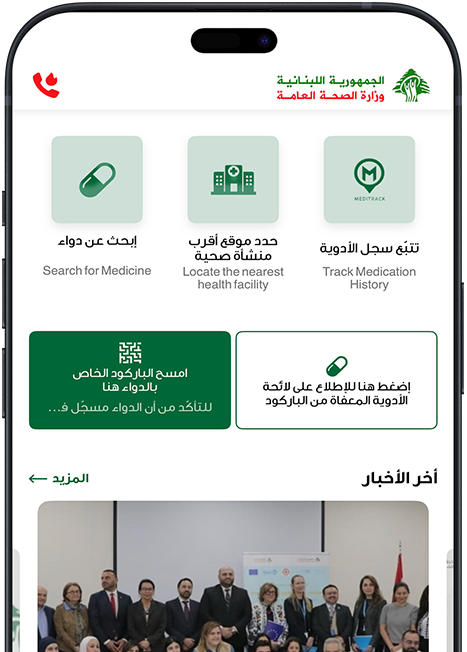
Download the new version of the Ministry of Public Health application and discover new features providing reliable health information
and advanced digital services.
The new version allows you to scan medicine barcodes to verify whether the medication is officially registered with the Ministry of Public Health and distributed through approved official channels, contributing to enhanced patient safety and reducing counterfeit and illegal medicines. In addition to other healthcare services, including:
- Tracking medication records on MediTrack
- Locating the nearest healthcare facility
- Accessing information and statistics on nurseries
- Following the latest health news and updates
The Ministry encourages citizens to rely exclusively on the official application as a trusted source for accurate and reliable health information.