Vector-Borne Diseases
 Vectors are living organisms that can transmit infectious diseases either between humans or from animals to humans.
Mosquitoes are the best known disease vector; others include ticks, flies, sand flies, fleas, triatomine, bugs and some freshwater aquatic snails.
Key Facts:
- Worldwide, vector-borne diseases account for more than 17% of all infectious diseases, causing more than 1 million deaths annually.
- More than 2.5 billion people in over 100 countries are at risk of contracting dengue alone.
- Malaria causes more than 400 000 deaths every year globally, most of them are children under 5 years.
- Other diseases, such as chagas disease, leishmaniasis and schistosomiasis, affect hundreds of millions of people worldwide.
- Main Reasons of disease transmission: globalization, travel and trade, unplanned urbanization and environmental challenges such as climate change
- Some diseases such as dengue, chikungunya and West Nile virus are emerging in countries for the first time
- In Lebanon, the Syrian crisis is a major risk factor for the emergence of vector-borne diseases due to displacement of carriers.
- The accumulation of the garbage in Lebanon and the warm weather constitute a favorable condition for the breeding of vectors such as rodents, insects, mosquitoes and ticks.

- Many of these diseases are preventable through appropriate protective measures.
Prevention:
It is important to take appropriate measures to protect yourself and your family from vector-borne diseases:
- Before you travel to yellow fever endemic countries make sure to be vaccinated ( Note that one dose is able to give life-long protection against yellow fever)The yellow fever vaccine is free of charge and available in the following centers:
| The Governorate | The Center | The Physician | The Phone Number |
|---|---|---|---|
| Beirut | Quarantine/ Beirut Rafic Hariri International airport | Dr. Atika Berry – Dr. Hasan Al Malah | 01/629325- 01/611845 |
| The North | Al Mina/ Quarantine | Dr. Akram Ghanem | 03/228846 – 06/600787 |
- Before temporary travel to malaria endemic countries , such as Central Africa, it is essential to take the anti-malarial preventive medications (dose and quantity are to be prescribed by physician in the center of Malaria Control)
| Name of the Center | Location | Phone Number | Physician |
|---|---|---|---|
| Center of Malaria Control | Karantina- Next to Sleep Comfort | 01/580660 | Dr. Najib Achi |
- Wear light-colored, long-sleeved shirts and long trousers that covers all the body
- Use insect repellent on exposed skin and clothing to protect yourself from being bitten by mosquitoes, sand flies or ticks (except for injured or allergic skin)
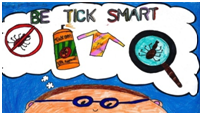
- Spray the inside of dwellings with an insecticide
- Use window screens to keep mosquitoes and insects outside the place where you are staying
- Close the windows and the doors and use air conditioner.
- Sleep under a white insecticide-treated bed net (156 holes per square inch), large enough to be fixed under the bed
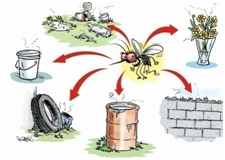
- Avoid or get rid of any media where the vector can breed, such as stagnant water in flower pots or used tires
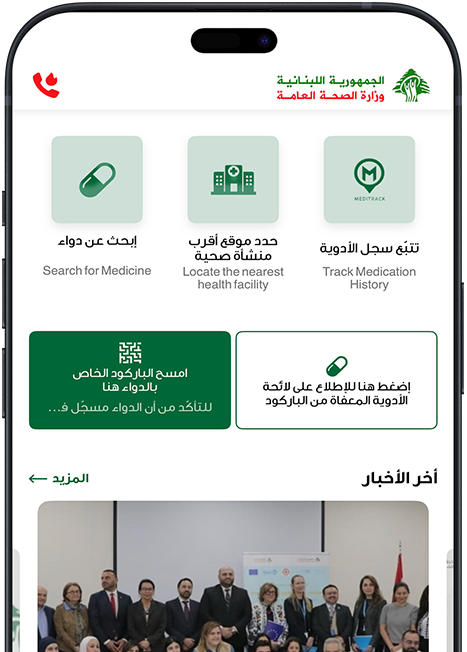
Download the new version of the Ministry of Public Health application and discover new features providing reliable health information
and advanced digital services.
The new version allows you to scan medicine barcodes to verify whether the medication is officially registered with the Ministry of Public Health and distributed through approved official channels, contributing to enhanced patient safety and reducing counterfeit and illegal medicines. In addition to other healthcare services, including:
- Tracking medication records on MediTrack
- Locating the nearest healthcare facility
- Accessing information and statistics on nurseries
- Following the latest health news and updates
The Ministry encourages citizens to rely exclusively on the official application as a trusted source for accurate and reliable health information.