Integration of Non-Communicable Disease Program in Primary Health Care
Integration of Non-Communicable Diseases Initiative within Primary Health Care Services
I. Introduction:
In 2012, the Primary Health Care Department at the Ministry of Public Health in collaboration with WHO, launched a pilot initiative of Non-Communicable Diseases (NCD) in the 26 Primary Health Care (PHC) centers that were classified in the Accreditation Preparedness Phase. By the year 2013, this Initiative was developed further and was integrated as a sustainable service into the package of health care services provided PHC centers across Lebanon. By the year 2015, the NCD program was integrated into a total of 146 centers across Lebanon.
This Initiative aims primarily at the early detection of diabetes, hypertension, and dyslipidemia through screening visitors of designated PHC centers who are 40 years and above. It further aims at the prevention of these diseases, promotion of health awareness, management of individuals with these pre-existing diseases, and surveillance of cardiovascular diseases in the Lebanese population. The risk for the development of diabetes, hypertension, and dyslipidemia is assessed by calculating the cardiovascular risk of each individual within the screening criteria. Once risk is calculated, education and referral for medical treatment as per PHC protocol is performed accordingly.
II- Trainings:
Therefore, in order to ensure proper implementation of this program and its continuity, health care providers were trained continuously. In 2012, the first phase of implementation included training of 91 health care providers. In 2013, additional 193 health care providers were trained and by the year 2014 training included another 230 health care providers. As a result, a total of 514 health care providers from PHC centers across Lebanon were trained over a period of 2 years. Besides these trainings, Refresher sessions were held for 135 already trained health care providers during the months of May and September of the year 2013. During this period, further work was prepared to develop educational material for the general population and develop the NCD e-module that aimed at enhancing and unifying the process of implementation and reporting.
| Year | NCD Trainings | NCD Refresher Sessions |
| Health Care Providers trained | Health Care Providers included | |
| 2012 | 91 | __ |
| 2013 | 193 | 135 |
| 2014 | 230 | 138 |
| Total: 514 | Total: 273 |
By the year 2014, aiming at ensuring the continuity of this initiative implementation, 3 additional Refresher Sessions were held during the months of February, October, and December, including 138 previously trained health care providers from PHC centers across Lebanon. During the month of December 2014, 2 full day NCD Refresher sessions were held for health care providers attending from different Qaza across Lebanon.
(Link to pictures of those trainings)
During 2015, 2 refresher sessions were held during the months of March and April for additional PHC centers within the National PHC Network.
(Link to pictures of those trainings)
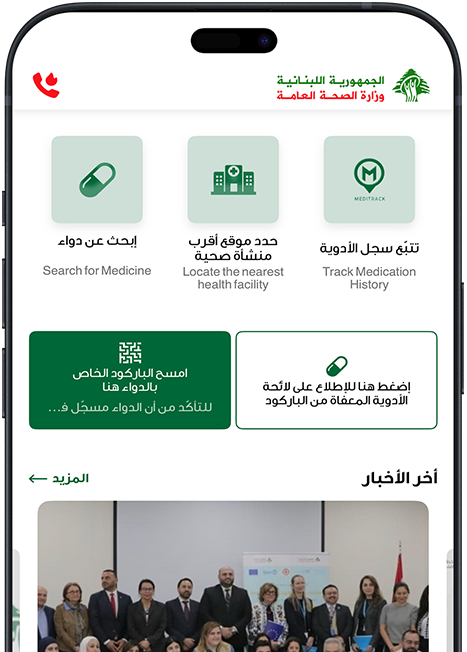
Download the new version of the Ministry of Public Health application and discover new features providing reliable health information
and advanced digital services.
The new version allows you to scan medicine barcodes to verify whether the medication is officially registered with the Ministry of Public Health and distributed through approved official channels, contributing to enhanced patient safety and reducing counterfeit and illegal medicines. In addition to other healthcare services, including:
- Tracking medication records on MediTrack
- Locating the nearest healthcare facility
- Accessing information and statistics on nurseries
- Following the latest health news and updates
The Ministry encourages citizens to rely exclusively on the official application as a trusted source for accurate and reliable health information.